
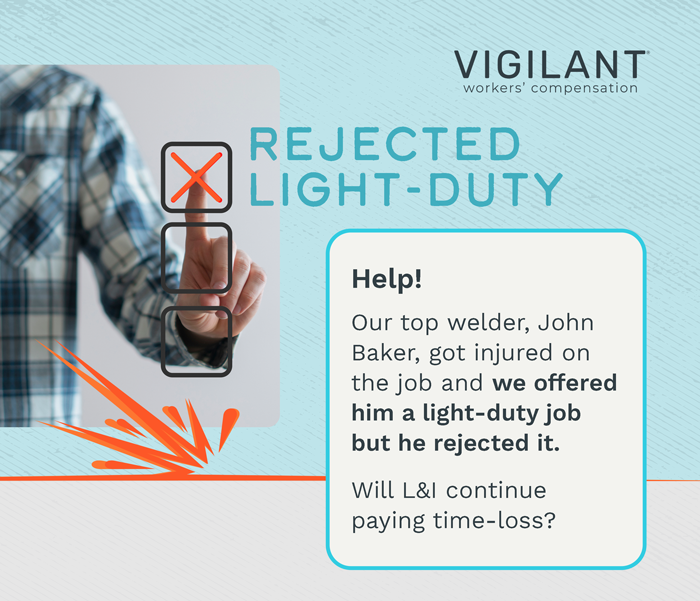
After a workplace injury an employee rejected your light-duty offer. Now What?
When an injured employee is medically able to return to work, a well-structured light-duty offer can benefit everyone. It can support recovery, keep the employee connected to the workplace, and reduce the cost of a claim.
But what happens when the employee rejects the offer? A rejection does not necessarily mean L&I must continue paying time loss benefits. However, the light duty offer must meet Washington L&I requirements before it can be used to stop time-loss.
All too often, seemingly minor errors – like missing start dates, omitted shift hours, or vague duty descriptions – render job offers technically invalid. These avoidable errors lead to unnecessarily prolonged time-loss, increasing claim costs, and increasing future premiums for the employer.
So what are Washington L&I’s standards for a rejected offer to legally stop time-loss benefits? To be valid, your offer must strictly include:
- Written Attending Physician Approval: Obtained before the offer goes to the worker.
- Clear Specifics:
- Precise job duties:
-
- Do this: Sitting at a height-adjustable workbench visually inspecting small plastic injection parts and logging pass/fail counts into a tablet.
- Don’t do this: Helping around the shop floor with light tasks (could this mean pushing heavy carts?) organizing inventory (could this include lifting?) and helping supervisors with light administrative paperwork as needed.
-
- Exact start date/time;
- Reporting location;
- Shift hours, and
- Pay rate.
- Precise job duties:
- Proper Notice: Delivered with sufficient written notice to the worker.
If any element is missing, L&I considers the offer invalid—and expensive time-loss payments may continue.
If the offer was valid, an unjustified refusal allows you to request that L&I terminate time-loss benefits—saving your business the financial consequences of ongoing time-loss payments from L&I.
How Vigilant Helps Take the Worry Out of Return-to-Work
You don’t have to guess or deal with the headache of an invalid offer after the fact. When you join one of Vigilant’s Washington Workers’ Comp programs, your dedicated claims manager works with you before you extend an offer. The rollout of L&I’s new Light Duty Dispute Resolution offices makes valid job offers more critical than ever, increasing the importance of getting the process right from the start. We help ensure your light duty job descriptions are physician-approved and 100% L&I-compliant right out of the gate.
Partner with Vigilant to remove the stress from return-to-work, streamline your claims, and get complete support for your entire workers’ comp strategy.

