
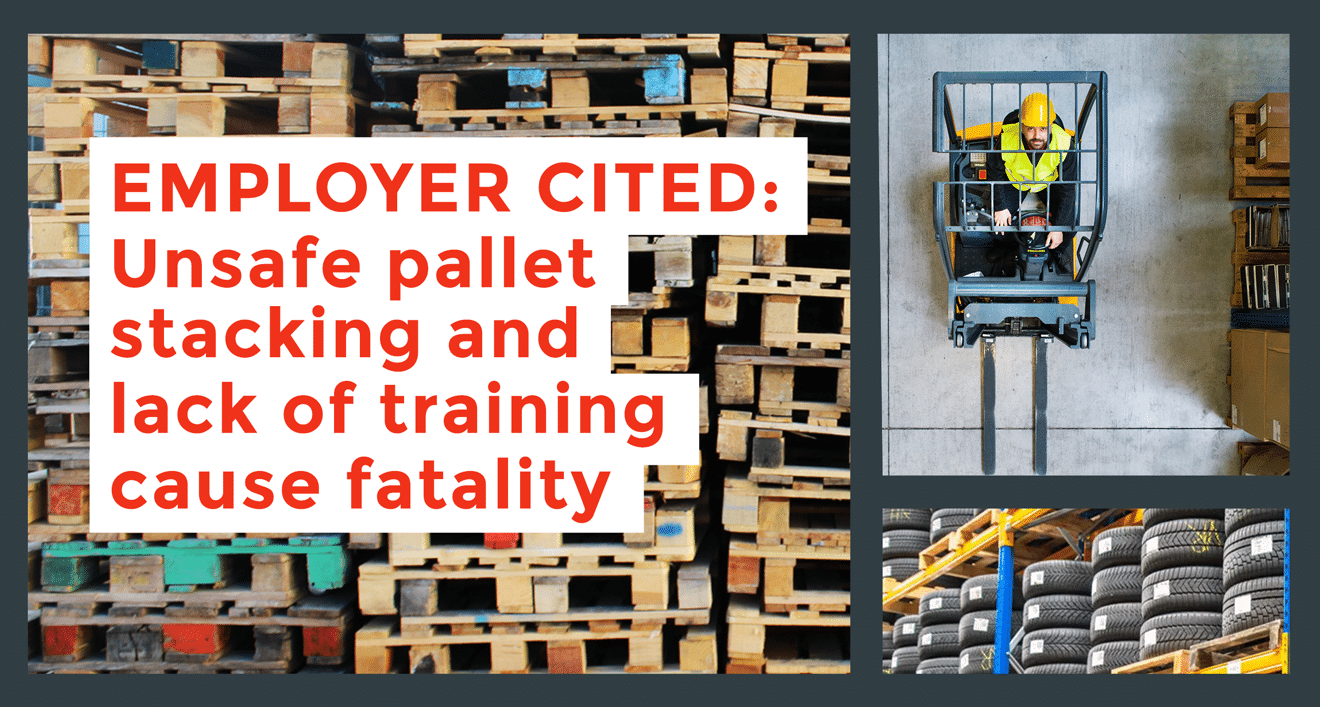
The federal Occupational Safety and Health Administration (OSHA) recently cited a tire facility for 12 violations and proposed $288,299 in penalties after a forklift operator was fatally struck by a falling pallet of industrial truck tires. According to OSHA’s citation and press release, the inspectors determined that the three-tier rack storage system’s vertical supports were damaged and the horizontal beam locks were missing. The OSHA investigation revealed that the facility failed to provide proper forklift safety training and to identify maximum load capacities on the pallet storage system. Half of the proposed penalty was due to OSHA’s assessment of a Willful-Serious citation for failing to train forklift operators.
Tips: OSHA doesn’t have specific standards for pallet stacking heights. The National Fire Protection Agency recommends that idle pallet stacks should not be higher than 15 feet, but the height ultimately depends on several factors including the type of goods, stacking method, whether the pallets are full or empty, and the materials being stacked. Vigilant also recommends the following safety tips to prevent stacked pallet accidents and/or OSHA citations:
- Forklift operators who approach pallet racks should be aware of potential instability of items on the racks. Operators should also consider whether the items are secured prior to lifting loads, or entering or exiting storage systems.
- Ensure that employees report damage to vertical storage racks, and that you have procedures in place to ensure repairs are made promptly. Proper forklift training can address the importance of reporting potential risks.
- Ensure that all racks are secured by bolting them to the ground or an approved wall or beam. Each rack has plates with bolt holes at the base of each upright beam. These holes hold the bolts and help maintain the strength of the rack to prevent tipping. You should add a review of these to your rack inspections.
- Ensure that racks hold the appropriate amount of weight. Each rack has load limits and is not intended to hold an unlimited amount of weight. The limit is measured in pounds and should be clearly visible on the front of the rack where the forklift operator places loads. You should contact the manufacturer for specifications.
- Ensure that all corner metal guards are set up properly. Some racking systems allow for corner metal guards around the two outer edges of each vertical rack. This acts as a “shield” and takes minor bumps from forklift traffic without touching the actual rack.
Vigilant members: Contact your Vigilant safety professional for assistance in assessing your safety compliance and potential risks. We can also help with training your forklift drivers, through our Forklift “Train the Trainer” program. For more information, or to request a class, contact our Safety Manager, Manish Gooneratne.
Protect your team and arm them with knowledge—contact Vigilant today to learn about our safety services and Forklift ‘Train the Trainer’ program.