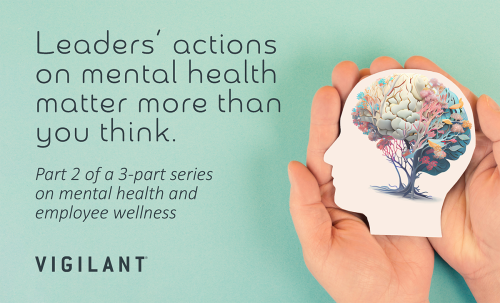
Workplace culture is one of the most significant influences on employee wellbeing.
In our last article, we shared data on workplace mental health that reflects what many Vigilant members are already navigating firsthand. We made the case that acknowledgement and open dialogue is the most practical place to start.
This is our second article in a three-part series on mental health. The World Health Organization (WHO) defines mental health not as the absence of illness, but as a state of wellbeing that enables people to cope with the stresses of life, realize their abilities, and work well. That distinction matters in a workplace context — mental health isn’t limited to diagnosable conditions or crisis situations. It encompasses how an employee manages daily stress, maintains focus, and shows up consistently over time. By the WHO definition, mental health is relevant to every person in your organization, every day.
Understanding what “mental health” means is a useful starting point, but it doesn’t automatically change how comfortable people feel talking about it. The National Alliance on Mental Illness (NAMI) 2025 Workplace Mental Health Poll found that 42 percent of employees worry their career would be negatively impacted if they talked about mental health concerns at work. In manufacturing, agriculture, and construction — where resilience and self-sufficiency are expected — that reluctance runs particularly deep. The gap between what employees are experiencing and what they’re willing to say out loud is real, and it starts with culture.
Culture is shaped, more than anything else, by what leaders say and do. In smaller organizations, that influence is even more direct. There is no buffer between leadership behavior and team culture when everyone works in the same building, on the same floor, or on the same job site.
The research is consistent on this point. Mental Health America’s decade of workplace data, drawing on nearly 75,000 employee surveys, identifies trust and psychological safety as the strongest predictors of employee wellbeing. Employees who feel genuinely supported by their direct manager report better mental health outcomes, regardless of what formal programs their employer offers. A 2023 Gallup study, as reported by PLANSPONSOR, reinforces the point: Workplaces that prioritize mental health see 13 percent higher productivity and a 2.6 times higher likelihood of reduced absenteeism. Those numbers don’t come from programs — they come from cultures where employees feel safe, supported, and seen by the people they work for.
None of this requires a formal program or a significant budget. What it does require is intention. Research points to a handful of leadership behaviors that move the needle in any work environment — and that are accessible to any leader, regardless of company size or resources:
- Start with an honest assessment: Before taking any action, pause and reflect — How is mental health awareness showing up in your organization right now? Is it a quiet strength you can build on, or a gap that needs addressing? What you see when you pay attention — and what you’re not seeing — is the most useful place to start.
- Normalize the conversation: Leaders who occasionally acknowledge their own stress in an appropriate and professional manner signal to employees that wellbeing is a legitimate topic, not a liability. That kind of openness takes a measure of courage — and in industries where self-reliance runs deep, it’s often the most powerful signal a leader can send.
- Check in genuinely: Brief, consistent conversations that include a sincere “how are you doing?” have real impact. Employees who feel seen by their manager are more likely to raise concerns early, before a challenge becomes a crisis.
- Respond with compassion: When an employee shares something difficult, the quality of that first response matters enormously. A calm, non-judgmental reply is the goal. Managers don’t need to have answers; they need to make sure speaking up doesn’t feel like a mistake. In fact, jumping in with a solution to “fix” the problem may not be what the person needs. Ask whether the individual would like suggestions for available resources.
- Involve Human Resources if appropriate: If an employee raises mental health as the reason they’re having performance or attendance issues, that’s the signal to pull in Human Resources. HR can then review the circumstances and ensure that the company complies with its legal obligations, which may include consulting with your company’s Vigilant Law Group employment attorney (if you’re a member), or your own legal counsel.
We find that most of our members aren’t looking to completely overhaul their culture — they’re looking for practical ways to support their people without making it feel like a bigger undertaking than it needs to be. The good news is that the most meaningful changes tend to be the simplest ones. The industries our members operate in are built on resilience, accountability, and showing up — and those are exactly the values that make a great foundation for this work. None of it requires a program, a budget, or a mandate. It requires leaders and managers who are willing to go first.
As always, if this topic is resonating — or if you’re trying something in your own organization that’s working — we’d love to hear from you. Help us shape this conversation by reaching out and sharing your thoughts.